Baldwin County Recycling Center Mural | Summerdale, Alabama
Turning Recycling Education Into Public Art
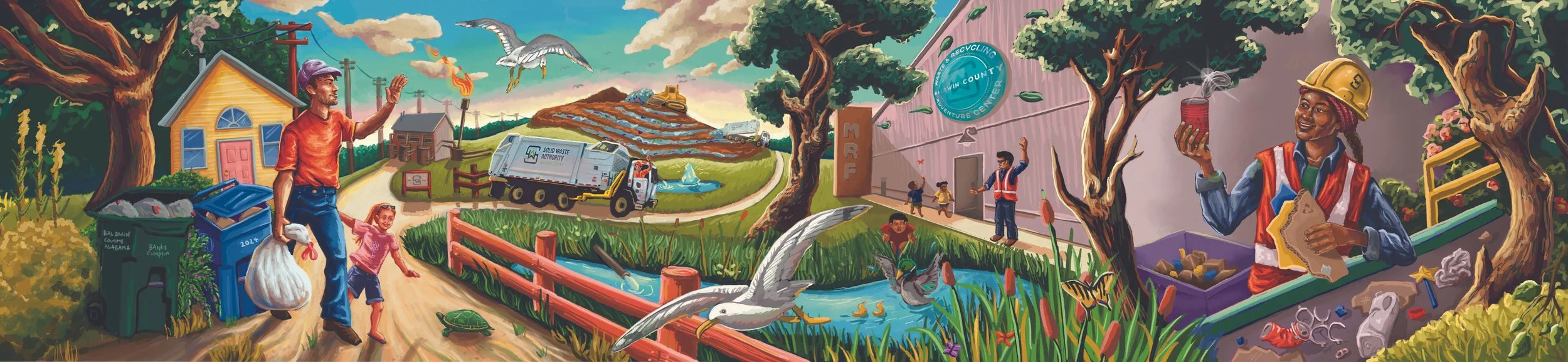
Alabama mural artist Banks Compton created this large-scale environmental education mural for the Solid Waste Disposal Authority of Baldwin County in Summerdale, Alabama.
Painted across a corrugated-metal water tank, the mural uses colorful characters and visual storytelling to explain what happens to waste after it leaves our homes—from collection and recycling to processing and disposal.
Designed for children, families, and visitors to the facility, the artwork transforms industrial infrastructure into an educational landmark while making complex environmental topics more approachable.
Project at a Glance
Artist: Banks Compton
Client: Solid Waste Disposal Authority of Baldwin County
Location: Summerdale, Alabama
Completed: 2025
Project Type: Public Art / Environmental Education Mural
Artwork: Large-scale exterior water tank mural
Surface: Curved corrugated metal
Theme: Recycling, waste management, sustainability & environmental education
Audience: Children, families & educational visitors
Purpose: Use public art and visual storytelling to help visitors understand the journey of waste and recycling
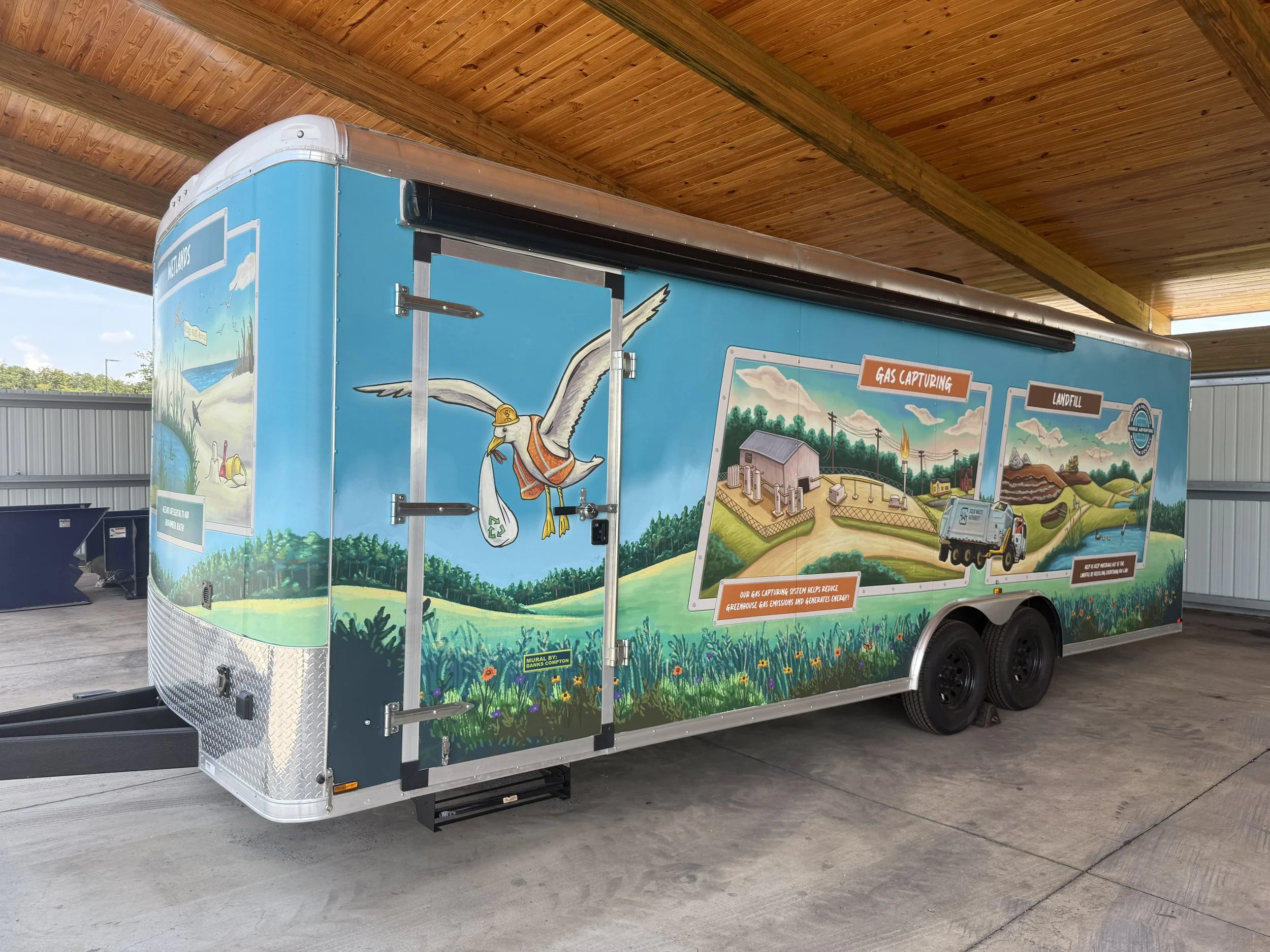
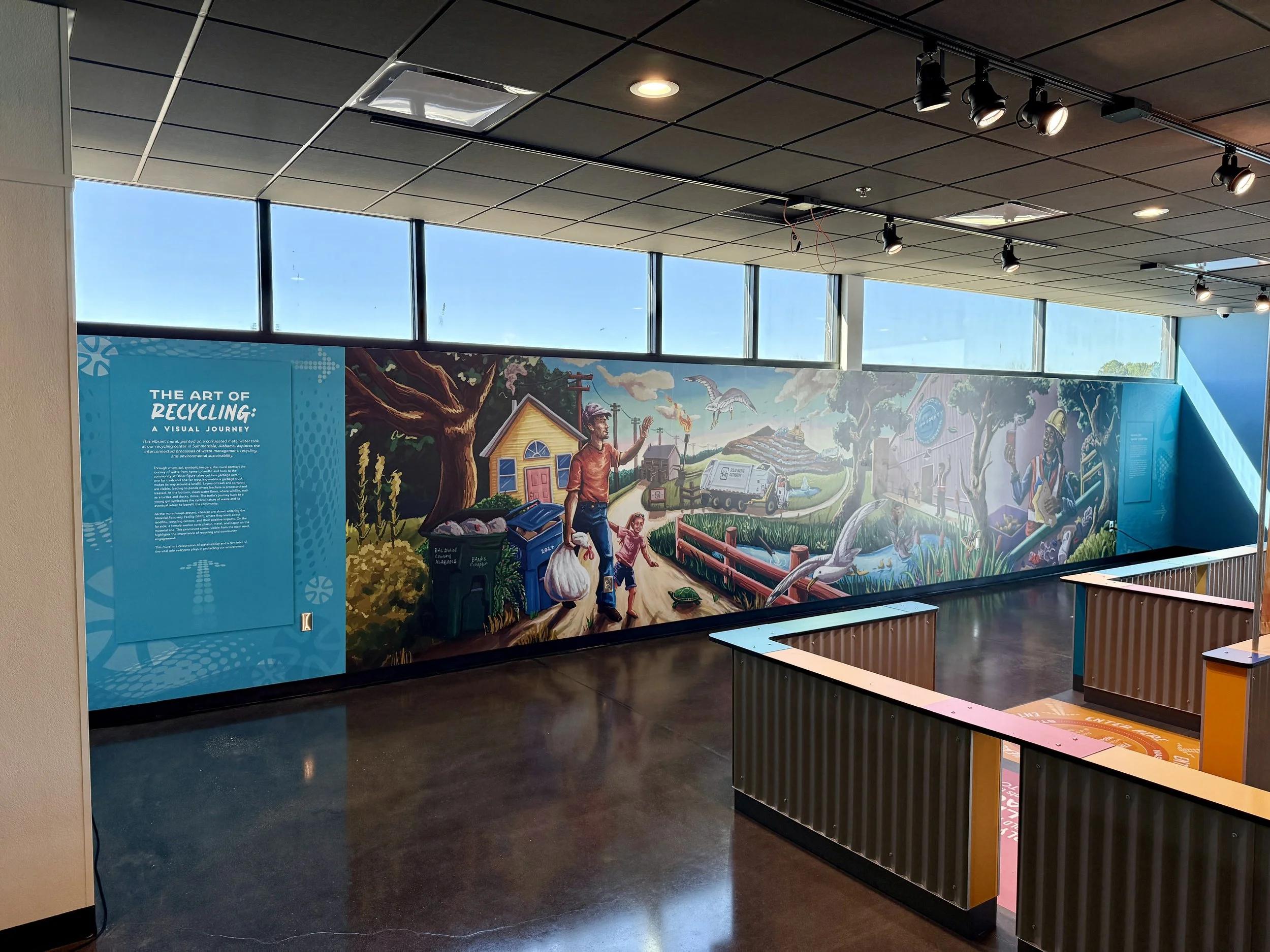
Additional Artwork: Indoor educational exhibit & mobile educational trailer
Art With an Educational Purpose
The Solid Waste Disposal Authority of Baldwin County's facility was designed not only to manage waste and recyclable materials, but also to help visitors understand what happens to those materials after they leave the curb.
The challenge for the mural was to turn a complicated process into something colorful, approachable, and memorable—particularly for younger visitors.
Rather than relying on text and diagrams alone, the mural uses characters, recognizable objects, movement, and visual storytelling to introduce concepts surrounding recycling, waste management, and environmental responsibility.
The result is public art that functions as both a landmark and an educational tool.
Teaching Recycling Through Visual Storytelling
The mural follows the journey of everyday waste through a series of interconnected scenes.
Objects and characters move through a landscape illustrating the relationship between our homes, the things we throw away, recycling, and the systems responsible for processing those materials.
Educational information is incorporated directly into the visual story rather than separated from the artwork. Children can first experience the mural as a colorful collection of characters and scenes before discovering the larger environmental message as they look more closely.
This approach demonstrates how murals can be used as educational tools, helping museums, schools, environmental organizations, and public facilities communicate complicated subjects through accessible visual storytelling.
Painting a Mural on a Corrugated-Metal Water Tank
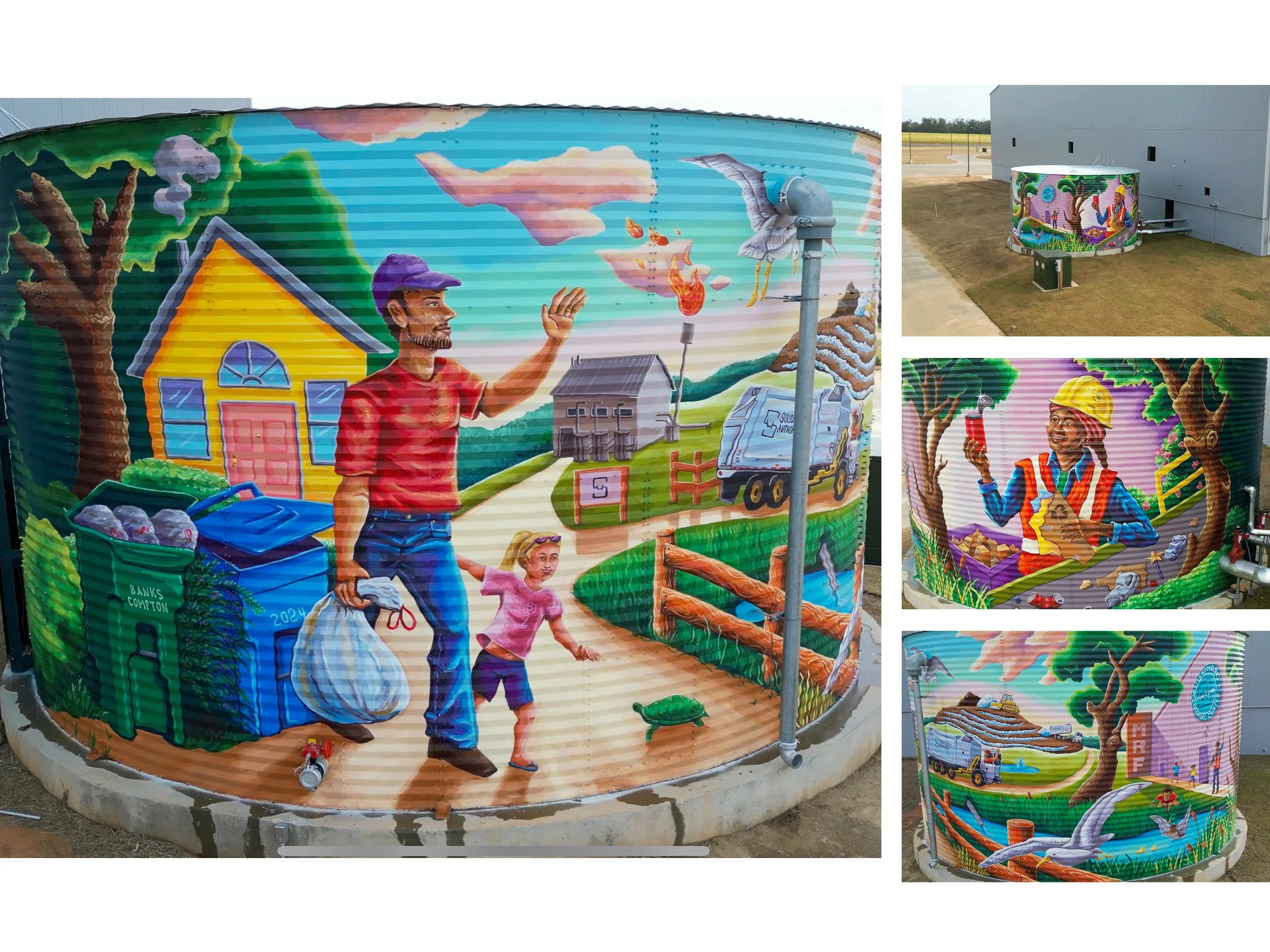
The mural was painted directly onto a large, curved corrugated-metal water tank at the Summerdale facility.
Unlike a traditional flat wall, the tank's curved profile and vertical corrugation required the composition to account for an industrial surface while remaining visually readable from multiple viewpoints.
The artwork also needed enough scale, contrast, and visual movement to remain impactful within the surrounding facility.
Industrial structures such as water tanks, silos, metal buildings, and other functional infrastructure can be transformed through murals into landmarks that contribute to the identity and visitor experience of a site.
At the Baldwin County facility, the water tank became part of the educational experience rather than remaining simply part of the background.
Expanding the Mural Into an Educational Exhibit
The visual identity developed for the mural eventually expanded beyond the water tank.
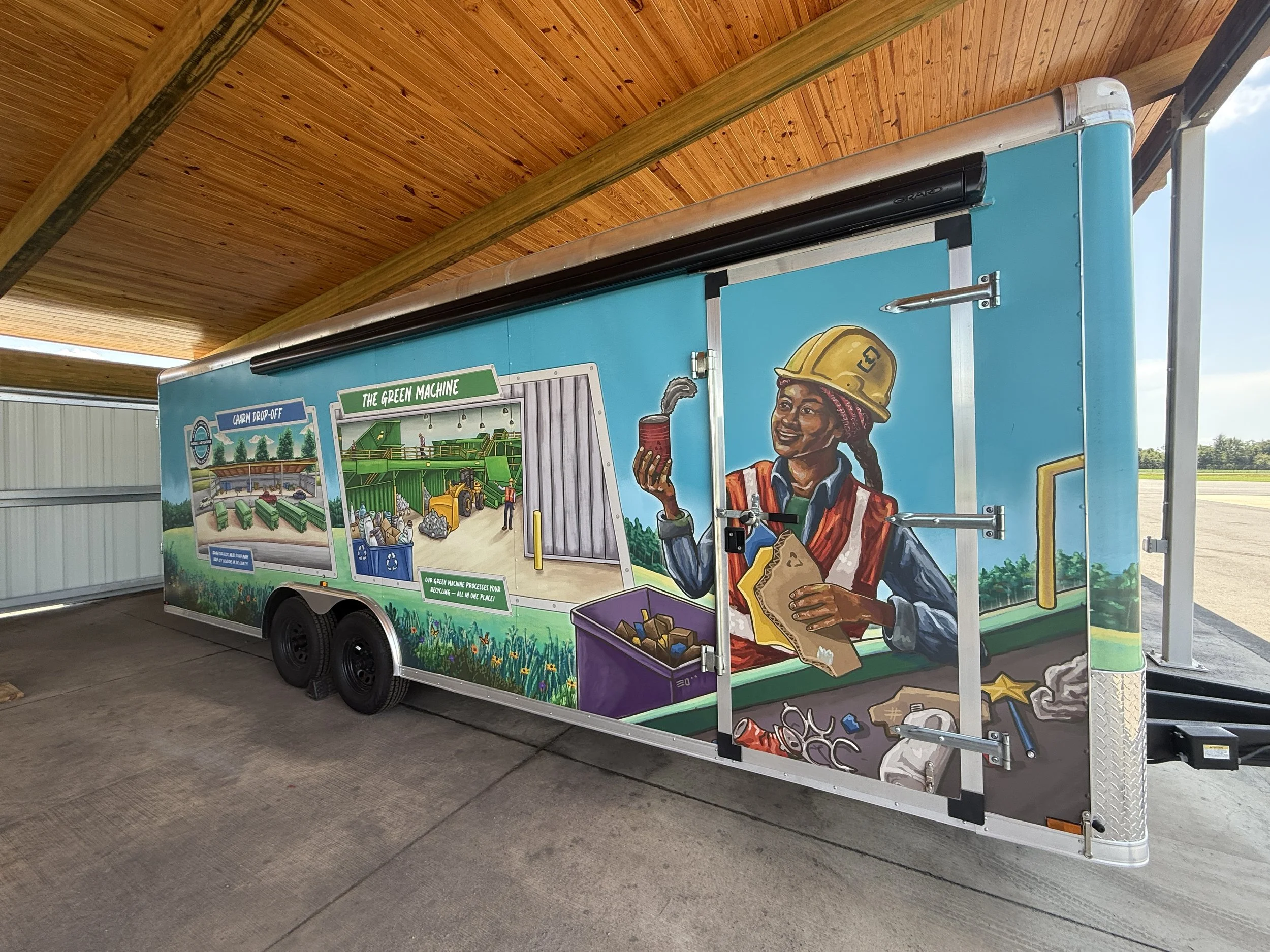
Characters, imagery, and environmental themes from the original artwork were adapted for an indoor educational exhibit and mobile educational trailer, creating a consistent visual experience across the Solid Waste Disposal Authority's environmental education programming.
Using the same visual language across murals, exhibits, and mobile educational materials helps visitors recognize connections between the different parts of the program.
The project demonstrates how a mural can become the foundation for a larger educational and visual identity rather than functioning only as a standalone piece of artwork.
Public Art and Environmental Education
Murals can help organizations communicate subjects that may otherwise be difficult to explain visually, including recycling, conservation, sustainability, history, science, and environmental systems.
Color, characters, storytelling, and recognizable imagery can make technical information more approachable while encouraging visitors to look closer and ask questions.
For the Baldwin County project, public art serves two purposes simultaneously: transforming an industrial environment and supporting the facility's environmental education mission.
Creating Public Art in Baldwin County
As an Alabama mural artist based in Baldwin County, Banks has created murals and public artwork for libraries, tourism destinations, businesses, educational facilities, public institutions, and community organizations throughout the area.
Each project is developed around its specific location, audience, and purpose.
For the Solid Waste Disposal Authority, that meant creating artwork capable of engaging children and families while supporting the educational mission of an active industrial facility.
The finished mural transforms functional infrastructure into a colorful Baldwin County landmark while helping visitors better understand the journey of the materials they use and discard every day.
About Banks Compton
Banks Compton is an Alabama mural artist and public artist creating large-scale, site-specific artwork throughout Alabama and across the United States.
A graduate of the Rhode Island School of Design (RISD), his work combines storytelling, nature, local culture, environmental themes, history, and site-specific imagery.
His projects range from public and community murals to artwork for schools, libraries, businesses, tourism organizations, civic institutions, and industrial facilities.
-
Yes. Murals can use visual storytelling, characters, diagrams, recognizable objects, and site-specific imagery to make topics such as recycling, conservation, sustainability, and environmental systems more approachable for visitors of different ages.
-
Yes. Murals can be designed for industrial surfaces including corrugated metal, tanks, silos, and metal buildings. Surface preparation, coatings, access, and environmental conditions must be evaluated for each project before painting begins.
-
Yes. Artwork developed for a mural can provide a visual foundation for related exhibits, signage, educational materials, and other applications when those uses are included in the project's scope and licensing. For the Baldwin County project, imagery from the mural was extended into an indoor educational exhibit and mobile educational trailer.
-
Yes. Banks creates site-specific murals for schools, libraries, public agencies, environmental organizations, museums, and other educational spaces. Projects can combine professional public art with educational themes, visual storytelling, and community engagement.
-
Banks works with cities, environmental organizations, schools, museums, educational facilities, public agencies, businesses, and community organizations throughout Alabama and the Southeast.
Projects can incorporate environmental education, local history, community stories, youth engagement, wayfinding, and site-specific storytelling while transforming functional spaces into memorable public landmarks.